


Клинический разбор в общей медицине №07 2026
Есть ли место послеоперационной химиолучевой терапии в современном лечении немелкоклеточного рака легкого?
Номера страниц в выпуске:7-14
Аннотация
Немелкоклеточный рак легкого (НМРЛ) является ведущей причиной смертности от рака во всем мире. Несмотря на достижения в диагностике и лечении, прогноз для пациентов с местно-распространенным заболеванием, особенно с поражением медиастинальных лимфатических узлов (pN2), остается неблагоприятным.
Адъювантная лекарственная терапия стала стандартом лечения для многих пациентов с НМРЛ стадии IB–IIIA после радикальной операции, демонстрируя улучшение показателей общей выживаемости. Однако роль послеоперационной лучевой терапии (ПОЛТ), а именно – комбинированной химиолучевой терапии, в адъювантном режиме для пациентов с НМРЛ стадии pN2 остается предметом интенсивных исследований и дискуссий.
С учетом высокой гетерогенности НМРЛ и постоянно развивающихся методов лечения, включая внедрение таргетной терапии и иммунотерапии, критически важно пересмотреть оптимальные возможности адъювантной терапии у пациентов с НМРЛ.
Целью исследования был анализ безопасности и эффективности адъювантной химиолучевой терапии в сравнении с адъювантной химиотерапией у пациентов с pN2 статусом после R0-резекции на основе изучения современных научных публикаций.
Для проведения данного сравнительного анализа был выполнен систематический обзор актуальной научной литературы, опубликованной в рецензируемых журналах, на основе запросов «немелкоклеточный рак легкого», «радикальная операция» и «послеоперационная лекарственная терапия». Основное внимание уделялось исследованиям, сравнивавшим адъювантную химиолучевую терапию и адъювантную химиотерапию у пациентов с НМРЛ стадии pN2 после радикальной операции. Анализ данных проводился с учетом показателей общей выживаемости, безрецидивной выживаемости, локального контроля и профилей токсичности. Особое внимание уделялось выявлению факторов, влияющих на выбор оптимальной стратегии для конкретного пациента.
С учетом текущих международных руководств, рутинное применение ПОЛТ у пациентов с рN2 НМРЛ не рекомендуется. Уровень доказательности в пользу комбинированного химиолучевого подхода уступает таковому для адъювантной лекарственной терапии, что диктует необходимость избирательной стратегии: лучевая терапия должна рассматриваться только в тех случаях, когда прогностические модели указывают на высокую вероятность пользы.
Ключевые слова: немелкоклеточный рак легкого, химиотерапия, лучевая терапия, адъювантная химиолучевая терапия, метастазы в медиастинальные лимфатические узлы.
Для цитирования: Саруханов Э.А., Афонин Г.В., Смоленов Е.И., Гулидов И.А., Прохожева В.А., Иванов С.А., Каприн А.Д. Есть ли место послеоперационной химиолучевой терапии в современном лечении немелкоклеточного рака легкого? Клинический разбор в общей медицине. 2026; 7 (7): 7–14. DOI: 10.47407/kr2026.7.07.00p4569
Немелкоклеточный рак легкого (НМРЛ) является ведущей причиной смертности от рака во всем мире. Несмотря на достижения в диагностике и лечении, прогноз для пациентов с местно-распространенным заболеванием, особенно с поражением медиастинальных лимфатических узлов (pN2), остается неблагоприятным.
Адъювантная лекарственная терапия стала стандартом лечения для многих пациентов с НМРЛ стадии IB–IIIA после радикальной операции, демонстрируя улучшение показателей общей выживаемости. Однако роль послеоперационной лучевой терапии (ПОЛТ), а именно – комбинированной химиолучевой терапии, в адъювантном режиме для пациентов с НМРЛ стадии pN2 остается предметом интенсивных исследований и дискуссий.
С учетом высокой гетерогенности НМРЛ и постоянно развивающихся методов лечения, включая внедрение таргетной терапии и иммунотерапии, критически важно пересмотреть оптимальные возможности адъювантной терапии у пациентов с НМРЛ.
Целью исследования был анализ безопасности и эффективности адъювантной химиолучевой терапии в сравнении с адъювантной химиотерапией у пациентов с pN2 статусом после R0-резекции на основе изучения современных научных публикаций.
Для проведения данного сравнительного анализа был выполнен систематический обзор актуальной научной литературы, опубликованной в рецензируемых журналах, на основе запросов «немелкоклеточный рак легкого», «радикальная операция» и «послеоперационная лекарственная терапия». Основное внимание уделялось исследованиям, сравнивавшим адъювантную химиолучевую терапию и адъювантную химиотерапию у пациентов с НМРЛ стадии pN2 после радикальной операции. Анализ данных проводился с учетом показателей общей выживаемости, безрецидивной выживаемости, локального контроля и профилей токсичности. Особое внимание уделялось выявлению факторов, влияющих на выбор оптимальной стратегии для конкретного пациента.
С учетом текущих международных руководств, рутинное применение ПОЛТ у пациентов с рN2 НМРЛ не рекомендуется. Уровень доказательности в пользу комбинированного химиолучевого подхода уступает таковому для адъювантной лекарственной терапии, что диктует необходимость избирательной стратегии: лучевая терапия должна рассматриваться только в тех случаях, когда прогностические модели указывают на высокую вероятность пользы.
Ключевые слова: немелкоклеточный рак легкого, химиотерапия, лучевая терапия, адъювантная химиолучевая терапия, метастазы в медиастинальные лимфатические узлы.
Для цитирования: Саруханов Э.А., Афонин Г.В., Смоленов Е.И., Гулидов И.А., Прохожева В.А., Иванов С.А., Каприн А.Д. Есть ли место послеоперационной химиолучевой терапии в современном лечении немелкоклеточного рака легкого? Клинический разбор в общей медицине. 2026; 7 (7): 7–14. DOI: 10.47407/kr2026.7.07.00p4569
Review
Varvara A. Prokhozheva1, Sergey A. Ivanov2,3, Andrey D. Kaprin3,4,5
1 Obninsk Institute of Atomic Energy – branch of the National Research Nuclear University MEPhI, Obninsk, Russia;
2 Tsyb Medical Radiological Research Centre – branch of the National Medical Research Radiological Centre, Obninsk, Russia;
3 Patrice Lumumba People’s Friendship University of Russia (RUDN University), Moscow, Russia;
4 National Medical Research Radiological Centre, Obninsk, Russia;
5 Hertsen Moscow Oncology Research Institute, Moscow, Russia
sarukhanovea20@oiate.ru
Abstract
Non-small cell lung cancer is the leading cause of cancer death worldwide. Despite advances in diagnostics and treatment, the prognosis for patients with locally advanced disease, particularly with mediastinal lymph node-positive disease (pN2), remains poor.
Adjuvant drug therapy has become the standard of care for many patients with stage IB–IIIA NSCLC following curative surgery, demonstrating improved overall survival. However, the role of postoperative radiation therapy (PORT), specifically combination chemoradiotherapy, in the adjuvant setting for patients with pN2 disease remains a subject of intense research and debate.
Given the high heterogeneity of NSCLC and continually evolving treatment modalities, including the introduction of targeted therapies and immunotherapy, it is critical to reassess the optimal adjuvant treatment options for patients with non-small cell lung cancer. The aim of this study was to analyze the safety and efficacy of adjuvant chemoradiotherapy compared with adjuvant chemotherapy in patients with pN2 NSCLC after R0 resection, based on a review of current scientific publications.
The aim of this study was to analyze the safety and efficacy of adjuvant chemoradiotherapy compared to adjuvant chemotherapy in patients with pN2 NSCLC after R0 resection, based on the study of current scientific publications.
To conduct this comparative analysis, a systematic review of the current scientific literature published in peer-reviewed journals was performed using search queries for “non-small cell lung cancer,” “radical surgery,” and “postoperative radiotherapy.” The primary focus was on studies comparing adjuvant chemoradiotherapy and adjuvant chemotherapy in patients with stage pN2 NSCLC after radical surgery. Data analysis was performed considering overall survival, relapse-free survival, local control, and toxicity profiles. Particular attention was paid to identifying factors influencing the selection of the optimal strategy for individual patients.
Given current international guidelines, the routine use of PORT in patients with pN2 NSCLC is not recommended. The level of evidence supporting the combined chemoradiotherapy approach is inferior to that for adjuvant chemotherapy, necessitating a selective strategy: radiotherapy should only be considered in cases when predictive models indicate a high likelihood of benefit.
Keywords: non-small cell lung cancer, chemotherapy, radiation therapy, adjuvant chemoradiation therapy, mediastinal lymph node metastases.
For citation: Sarukhanov E.A., Afonin G.V., Smolenov E.I., Gulidov I.A., Prokhozheva V.A., Ivanov S.A., Kaprin A.D. Is there a place for postoperative chemoradiotherapy in the modern treatment of non-small cell lung cancer? Clinical review for general practice. 2026; 7 (7): 7–14 (In Russ.). DOI: 10.47407/kr2026.7.07.00p4569
Введение
Адъювантная химиотерапия на основе платины стала стандартом лечения для пациентов с немелкоклеточным раком легкого (НМРЛ) стадии II–IIIA после полной резекции, улучшая 5-летнюю общую выживаемость на 5–10% (абсолютный прирост) [1]. Данная терапия направлена на уничтожение микрометастазов, которые могли распространиться за пределы первичной опухоли и регионарных лимфатических узлов, тем самым снижая риск развития отдаленных рецидивов. Однако, несмотря на системное действие, адъювантная химиотерапия не всегда обеспечивает адекватный локальный контроль, что может способствовать возникновению локорегионарных рецидивов [1]. В этом контексте результаты исследования III фазы ADAURA открыли новые возможности для пациентов с мутациями в гене EGFR (ex19del или L858R). Применение адъювантного осимертиниба в течение 3 лет после радикальной операции продемонстрировало беспрецедентное преимущество в общей выживаемости: риск смерти был снижен на 51% [отношение рисков (ОР) 0,49; 95% доверительный интервал (ДИ) 0,34–0,70; p<0,0001], а 5-летняя общая выживаемость у пациентов со стадией IB–IIIA достигла 88% (в группе плацебо – 78%), причем этот эффект наблюдался вне зависимости от проведения предшествующей адъювантной химиотерапии [2]. Более того, препарат показал высокую эффективность в предотвращении метастазирования в центральную нервную систему (ЦНС): риск развития метастазов в ЦНС или смерти снизился на 64% (ОР 0,36; 95% ДИ 0,18–0,73) [2], что делает его новым стандартом терапии для данной подгруппы пациентов.
Послеоперационная лучевая терапия (ПОЛТ) при НМРЛ прошла долгий и противоречивый путь эволюции. В середине XX в. ПОЛТ широко применялась в общеклинической практике с целью улучшения локального контроля после хирургического этапа лечения пациентов с НМРЛ, исходя из предположения, что удаление опухоли не всегда гарантирует полное устранение микроскопических остаточных клеток [3, 4]. Однако первые рандомизированные исследования не показали явного преимущества в выживаемости, а некоторые даже намекали на возможный вред [4].
Одной из наиболее ключевых работ стал крупный метаанализ PORT Collaboration Group от 1998 г. [4]. В работе представлены результаты девяти рандомизированных исследований с участием 2128 пациентов, и результаты показали, что ПОЛТ после радикальной операции увеличивала смертность у пациентов с I и II стадией НМРЛ, а у пациентов с III стадией преимущества не были статистически значимыми (ОР 0,97 и 0,96 соответственно). Этот вывод привел к значительному сокращению использования ПОЛТ, особенно при ранних стадиях заболевания.
После публикации данного метаанализа исследователи осознали, что старые исследования имели ряд ограничений: устаревшие методики лучевой терапии (двухмерное планирование), большой объем облучаемых нормальных тканей, высокие дозы облучения, частое включение пациентов с N0/N1-статусом, которым ПОЛТ приносила больше вреда, чем пользы. Ярким примером тому стала отсроченная кардиальная летальность. Главный риск заключался в том, что пациенты умирали не от рецидива рака, а от сердечной недостаточности, вызванной лечением [4].
Начиная с 2000-х годов фокус внедрения ПОЛТ сместился на пациентов с поражением медиастинальных лимфатических узлов (рN2), у которых риск местного рецидива был значительно выше. Также совершенствование технологий: внедрение в общеклиническую практику позитронно-эмиссионной томографии, совмещенной с компьютерной томографией (ПЭТ/КТ), и методик лучевой терапии – трехмерной конформной лучевой терапии (3D-CRT) и модулированной по интенсивности лучевой терапии (IMRT) для более прецизионного облучения – позволило снизить риск развития осложнений со стороны сердечно-сосудистой системы.
Исследования ANITA (2006) [5] и NCIC CTG BR.10 (2006) [6], в которых изучалась роль адъювантной химиотерапии, показали, что добавление химиотерапии пациентам с N2-статусом НМРЛ ассоциировалось с улучшением выживаемости и локального контроля по сравнению с группой наблюдения.
Исследование ANITA (Adjuvant Navelbine International Trialist Association). Данная работа является крупным международным исследованием
III фазы, включавшим пациентов с НМРЛ после радикального хирургического лечения со стадиями IB (T2N0), II и IIIA. Основной целью было сравнение общей выживаемости у пациентов, получавших адъювантную химиотерапию, и пациентов, находившихся под наблюдением.
В период с декабря 1994 г. по декабрь 2000 г. 840 пациентов из 101 центра в 14 странах были рандомизированы в две группы: группу наблюдения после операции (n=433) и группу адъювантной химиотерапии (n=407). Пациенты в группе химиотерапии получали четыре цикла винкристина (навельбина) в дозе 30 мг/м2 еженедельно и цисплатина в дозе 100 мг/м2 каждые 4 нед.
Исследование продемонстрировало статистически значимое улучшение общей выживаемости в группе химиотерапии. ОР смерти составило 0,80 (95% ДИ 0,66–0,96; p=0,017). Абсолютное улучшение 5-летней выживаемости составило 8,6% (с 42,6% в группе наблюдения до 51,2% в группе химиотерапии); этот эффект сохранялся и через 7 лет наблюдения. Наибольшую пользу от лечения получили пациенты со стадиями II (улучшение 5-летней выживаемости на 13%) и IIIA (улучшение на 16%). Авторы отметили, что, хотя режим был эффективен, он оказался достаточно токсичным. Полный курс из четырех запланированных циклов завершили только половина пациентов. Наиболее частыми нежелательными явлениями 3–4-й степени были нейтропения (в том числе фебрильная) и анемия.
Стоит отметить, что 2% пациентов умерли от токсических эффектов, связанных с лечением, что выше, чем в аналогичных исследованиях. Исследователи предположили, что это может быть связано с относительно высокими дозами препаратов. Но данное исследование укрепило позиции адъювантной химиотерапии на основе винкристина и цисплатина как стандарта лечения для пациентов с операбельными стадиями НМРЛ (II–IIIA).
Исследование NCIC CTG BR.10 (JBR.10). В исследование включались пациенты после радикальных операцией по поводу НМРЛ IB (T2N0) и II (T12N1) стадии. Целью была оценка влияния адъювантной химиотерапии на общую и безрецидивную выживаемость.
Пациенты были рандомизированы в группу наблюдения или в группу, получившую четыре цикла химиотерапии винкристином и цисплатином. Важными особенностями этого исследования были более строгий отбор пациентов (только стадии IB и II) и отсутствие ПОЛТ в протоколе.
Результаты, впервые представленные в 2004 г. и опубликованные в 2005 г., показали снижение риска смерти на 30% (ОР 0,69; p=0,04). Абсолютное улучшение 5-летней выживаемости составило 15% (с 54% в группе наблюдения до 69% в группе химиотерапии), а медиана выживаемости увеличилась на 21 мес. Последующий анализ подтвердил, что этот положительный эффект сохраняется со временем. Отдельный ретроспективный анализ показал, что пациенты старше 65 лет также получают значительную пользу от химиотерапии (ОР 0,61; p=0,04), несмотря на то что они получили меньшие дозы препаратов и у них была приемлемая токсичность.
В исследовании ANITA нежелательные явления были существенными, однако поддавались коррекции. Пожилые пациенты получали меньшие дозы и реже завершали полный курс лечения, но частота тяжелых побочных эффектов и госпитализаций значимо не отличалась от таковой у более молодых пациентов.
Сравнение адъювантной химиолучевой терапии и адъювантной химиотерапии
Для пациентов с НМРЛ после радикальной резекции применение ПОЛТ теоретически обеспечивает преимущества в отношении как системного, так и локального контроля. Медикаментозная противоопухолевая терапия направлена на эрадикацию отдаленных микрометастазов, тогда как локальная лучевая терапия ориентирована на элиминацию резидуальных микроскопических опухолевых клеток в области оперативного вмешательства и регионарных лимфатических узлов.
У пациентов с патологически подтвержденной стадией pN2 после радикальной резекции (R0) адъювантная химиолучевая терапия теоретически обладает двойным онкологическим эффектом: системным контролем гематогенного метастазирования за счет химиотерапии и локорегионарным контролем остаточных субклинических опухолевых очагов в ложе удаленной опухоли и зонах регионарного лимфооттока посредством лучевого воздействия. В метаанализе Z. Wang и соавт. (2022), включившем 4111 пациентов, подтверждается, что ПОЛТ способствует повышению локального контроля, а у тщательно отобранных пациентов с НМРЛ и поражением лимфатических узлов (N2) может также улучшать общую выживаемость [7]. На сегодняшний день наиболее актуальными и доказательными исследованиями, оценивающими эффективность послеоперационной химиолучевой терапии, являются работы PORT-C и LungART [7–9].
Результаты исследований PORT-C и LungART. Исследование III фазы PORT-C, результаты которого были опубликованы в 2021 г., стало первым рандомизированным исследованием III фазы, оценивающим роль современной лучевой терапии после радикальной операции у пациентов с НМРЛ в китайской популяции. В исследуемой группе проводилась 3D-CRT или лучевая терапия с модулированной интенсивностью. В исследование были включены 394 пациента, но только
310 больных (из которых 140 получали ПОЛТ) были включены в финальный анализ.
Результаты исследования показали, что у пациентов, получивших ПОЛТ, был снижен риск местного рецидива по сравнению с контрольной группой (ОР 0,71; 95% ДИ 0,51–0,97). Однако это не привело к улучшению показателя безрецидивной выживаемости.
Важно отметить, что разницы в общей выживаемости между группами выявлено не было (ОР 1,02; 95% ДИ 0,68–1,52). Авторами отмечено, что было отсутствие зарегистрированных побочных эффектов 4-й или 5-й степени, связанных с лучевой терапией, и лишь у одного пациента (0,7%) наблюдался лучевой пневмонит 3-й степени [9].
В 2022 г. были опубликованы результаты многоцентрового исследования III фазы LungART. В исследовании, включающем 501 пациента, было показано, что ПОЛТ значительно снижает риск локорегионарного рецидива (14% против 23% в группе без ПОЛТ), но не влияет на выживаемость без признаков заболевания и общую выживаемость [8].
Стоит отметить, что нежелательные явления встречались чаще в группе ПОЛТ (89% против 74%), при этом особую обеспокоенность вызывала кардиопульмональная токсичность 3-й или 4-й степени, которая была зарегистрирована у 11% пациентов в группе ПОЛТ по сравнению с 5% пациентов в контрольной группе [9].
При интерпретации результатов исследований PORT-C и LungART необходимо обратить внимание на то, что в испытание PORT-C были включены только пациенты с заболеванием pIIIA-N2 согласно Международной классификации стадий злокачественных новообразований (TNM) 6-го или 7-го издания, что исключало пациентов с IIIB стадией (рN2) согласно 8-му изданию классификации TNM. В исследовании LungART эти пациенты не исключались (допускались ипсилатеральные очаги, pT4), но их результаты подробно не сообщаются, что ограничивает понимание эффективности ПОЛТ в этой конкретной популяции. Хотя доля таких пациентов, выбранных для хирургического лечения, невелика, они представляют собой подгруппу с особенно высоким риском местного рецидива и отдаленного метастазирования [9].
Также при оценке объема хирургической резекции в исследовании PORT-C количество обнаруженных лимфатических узлов и количество положительных лимфатических узлов рассматривались как факторы риска развития безрецидивной выживаемости. Она значительно различалась после стратификации в зависимости от количества обнаруженных и положительных лимфатических узлов (ОР 0,75; 95% ДИ 0,58–0,98), но выбранные пороговые значения не были опубликованы. Это подчеркивает необходимость более сложных инструментов отбора, учитывающих различные факторы риска.
В исследовании LungART был проведен пересмотр хирургических образцов в лаборатории для повторной оценки инвазии экстракапсулярных узлов, учитывая ее негативное влияние на выживаемость, выявленное в ранее опубликованном метаанализе [8]. После пересмотра только 28% пациентов были признаны радикально оперированными (R0), что поставило под сомнение адекватность патологической стадии у оставшихся 72% пациентов и предсказуемость резекции R0 перед операцией. Таким образом, представленные исследования подчеркивают критическую важность точной патологической оценки для прогнозирования риска и выбора оптимальной терапевтической тактики.
Также стоит отметить, что наиболее существенным ограничением является медленное накопление данных, что не позволило завершить эти испытания вовремя, чтобы идти в ногу с технологическим прогрессом в области лучевой терапии. Когда эти испытания разрабатывались, IMRT была инновационной техникой с ожидаемой пользой, которую еще предстояло полностью оценить.
Исследования PORT-C и LungART, несмотря на их ограничения, предоставляют важные данные о роли адъювантной лучевой терапии у пациентов с резецированным N2-статусом НМРЛ. Они показывают, что ПОЛТ может снижать риск местного рецидива, но не приводит к улучшению общей выживаемости и может сопровождаться повышенной токсичностью. Необходимы дальнейшие исследования для определения оптимальных кандидатов для ПОЛТ и разработки более точных прогностических моделей.
В популяционном когортном исследовании C.Y. Tu и соавт. от 2022 г. [10], фокусирующемся на пациентах с микроскопически позитивным краем резекции (R1), предоставлены данные для сравнения адъювантной химиолучевой терапии и химиотерапии. В этом исследовании проведение адъювантной химиолучевой терапии было связано с улучшенной общей выживаемостью по сравнению с адъювантной химиотерапией у пациентов с местно-распространенным НМРЛ и R1-резекцией. Это исследование показывает, что для пациентов с высоким риском локального рецидива добавление лучевой терапии к химиотерапии может быть выгодным. Несмотря на патоморфологические различия в статусе pN2 после радикальной резекции (R0) и неполной резекции (R1), высокий риск локорегионарного рецидива, характерный для обоих клинических случаев, обосновывает актуальность их сравнения.
В исследовании, направленном на поиск оптимального метода лечения НМРЛ после хирургического вмешательства с пораженными медиастинальными лимфатическими узлами, проанализированы данные из базы Surveillance, Epidemiology, and End Results (SEER), предоставляющие информацию об онкологических заболеваниях в США. В исследование включены пациенты с рN2 после радикального хирургического лечения, которым была проведена радикальная операция в период с 2010 по 2015 г. Пациенты были разделены на две группы: получавшие послеоперационную адъювантную химиотерапию и послеоперационную адъювантную химиолучевую терапию. Для минимизации систематических ошибок, связанных с различиями в характеристиках пациентов между группами, было применено сопоставление по методу статистической оценки (Propensity Score Matching, PSM). Основной конечной точкой исследования была общая выживаемость. Анализ данных показал, что пациенты, получавшие только адъювантную химиотерапию, имели статистически значимо лучшую общую выживаемость по сравнению с пациентами, получавшими адъювантную химиолучевую терапию, как до, так и после сопоставления по методу статистической оценки.
Медиана общей выживаемости в группе адъювантной химиотерапии составила 48 мес, в то время как в группе ПОЛТ – 39 мес (ОР 0,84; 95% ДИ 0,71–0,99; p=0,031) после статистической оценки [11]. Регрессионный анализ Кокса выявил ряд независимых прогностических факторов, влияющих на выживаемость. К факторам, ассоциированным с худшим прогнозом, относились: пожилой возраст (старше 60 лет), мужской пол, более высокая стадия T (T3–T4) и больший диаметр опухоли. Напротив, адъювантная химиотерапия без лучевой терапии была идентифицирована как благоприятный прогностический фактор [10]. На основе этих факторов была построена прогностическая модель, позволяющая оценить вероятность пользы от адъювантной химиотерапии. Модель показала хорошую предсказательную способность с AUC значений 0,723 для обучающей выборки, 0,710 для внутренней валидации и 0,729 для внешней валидации [11].
Дальнейший анализ позволил стратифицировать пациентов на группы с высокой и низкой вероятностью пользы от адъювантной химиотерапии. Пациенты из группы с высокой вероятностью пользы (вероятность пользы >0,62) демонстрировали значительно лучшую выживаемость при получении только химиотерапии по сравнению с группой адъювантной химиолучевой терапии [11].
Это исследование, основанное на анализе данных SEER (что соответствует реальной клинической практике), хоть и показывает, что адъювантная химиотерапия превосходит адъювантную химиолучевую терапию по показателям общей выживаемости у пациентов с НМРЛ и статусом рN2, но и свидетельствует, что необходимо более точно идентифицировать пациентов, которые могут получить наибольшую пользу от
адъювантной химиотерапии; это способствует персонализированному подходу к лечению. Таким образом, баланс между эффективностью и безопасностью является ключевым при выборе стратегии лечения.
Послеоперационное лечение НМРЛ: достижения лекарственной и лучевой терапии
Изначально иммунотерапия применялась только при метастатическом НМРЛ. На сегодняшний день взаимодействие лучевой терапии и иммунотерапии представляет собой область интенсивных и динамично развивающихся исследований в онкологии, хотя прямых и убедительных доказательств их синергического эффекта в периоперационных условиях пока еще недостаточно для широкого клинического применения [12]. Значительный прогресс в адъювантной терапии был достигнут в исследовании IMpower010, где атезолизумаб (ингибитор PD-L1) после адъювантной химиотерапии платиной сравнивался с наблюдением у пациентов с резецированным НМРЛ стадии IB–IIIA. В популяции с экспрессией PD-L1 ≥1% (стадии II–IIIA) атезолизумаб улучшил безрецидивную выживаемость (ОР 0,66; 95% ДИ 0,50–0,88), а наибольший эффект наблюдался при PD-L1 ≥50% (ОР 0,43). Однако терапия ассоциировалась с более высокой частотой нежелательных явлений 3–4-й степени (22% против 12% в группе наблюдения).
В свою очередь в исследовании PEARLS/KEYNOTE-091 оценивался адъювантный пембролизумаб (ингибитор PD-1) без обязательной предшествующей химиотерапии у пациентов с НМРЛ стадии IB–IIIA. В отличие от исследования IMpower010, пембролизумаб продемонстрировал значимое преимущество в DFS в общей популяции (ОР 0,76; 95% ДИ 0,63–0,91), включая пациентов с PD-L1 <1%, однако оно не достигло статистической значимости в подгруппе PD-L1 ≥50% (ОР 0,82; p=0,14). Частота серьезных нежелательных явлений составила 26% против 16% в группе плацебо.
Таким образом, оба исследования подтвердили роль адъювантной иммунотерапии при резецированном НМРЛ, однако ключевое различие заключается в том, что исследование IMpower010 показало эффект преимущественно при PD-L1 ≥1% (максимально – при PD-L1 ≥50%), тогда как исследование PEARLS/KEYNOTE-091 продемонстрировало пользу в общей популяции, включая пациентов с низкой экспрессией PD-L1, но без подтвержденного эффекта при высоком PD-L1 (≥50%). Несмотря на значительное улучшение показателей безрецидивной выживаемости и выживаемости без отдаленных метастазов, риск местного рецидива остается на уровне, наблюдавшемся до эры иммунотерапии. Это вновь оживляет интерес к ПОЛТ в контексте местного контроля [12].
Потенциально взаимодействие радиации и иммунотерапии активно изучается, хотя прямых доказательств в периоперационных условиях пока недостаточно. Лучевая терапия не только напрямую повреждает опухолевые клетки, но и может стимулировать иммунную систему посредством множества механизмов [13]. Помимо индукции двухцепочечных разрывов ДНК в опухолевых клетках, излучение вызывает высвобождение иммуностимулирующих молекул, ремоделирует сосудистую сеть опухоли и влияет на привлечение лимфоцитов в микроокружение опухоли [14]. Также отмечается, что радиотерапия может увеличивать экспрессию PD-L1 на опухоли, делая ее более чувствительной к ингибиторам иммунных контрольных точек [15]. Эти механизмы могут способствовать преимуществам лучевой терапии, когда системный иммунный ответ, вызванный радиотерапией, поддерживает отдаленную регрессию опухоли в так называемом ингибирующем эффекте.
Эти иммуномодулирующие механизмы могут способствовать возникновению феномена, известного как абскопальный эффект. Этот редкий, но системный иммунный ответ заключается в регрессии отдаленных, необлученных метастазов опухоли после локальной лучевой терапии первичного очага [12]. Абскопальный эффект является прямым доказательством способности лучевой терапии активировать системный противоопухолевый иммунитет.
Однако сочетание ПОЛТ и иммунотерапии вызывает опасения по поводу безопасности и потенциального иммуносупрессивного действия радиации. На эти эффекты влияют множество факторов, таких как общая доза, фракционирование, объем облучаемых тканей, общее время лечения и доза облучения ключевых органов, включая лимфатические узлы, селезенку и кости, содержащие костный мозг. Научный интерес к новым стратегиям, направленным на сохранение лимфоцитов, растет [16]. Это стимулирует проведение специализированных клинических испытаний, таких как исследование PACCELIO (NCT06102057), в котором оценивается корректировка дозы и целевых объемов для неоперабельного НМРЛ с целью снижения облучения здоровых лимфоидных структур [17]. Эти подходы, наряду с более широким использованием интенсивной модулированной по интенсивности лучевой терапии, прокладывают путь для дальнейших клинических испытаний, изучающих взаимодействие между радиацией и иммунной системой.
В ряде исследований, оценивающих адъювантную или периоперационную иммунотерапию, ПОЛТ являлась критерием исключения. Однако ряд исследований, изучающих влияние иммунотерапии в периоперационном периоде, допускали ПОЛТ при определенных обстоятельствах.
Например, в исследовании III фазы KEYNOTE-671 [18], оценивавшем периоперационную комбинацию пембролизумаба и химиотерапии при НМРЛ стадии II–IIIB после резекции (согласно TNM 8-го издания), пациентам с микроскопически положительными краями (R1), массивной остаточной болезнью или экстракапсулярным лимфатическим распространением была проведена ПОЛТ, в то время как пациенты с радикальной R0-резекцией и проведенной ПОЛТ и пораженными медиастинальными лимфатическими узлами были исключены.
Аналогичным образом, другие исследования фазы III допускали применение ПОЛТ по усмотрению исследователей, например CheckMate-816, изучающее неоадъювантное лечение ниволумабом с химиотерапией при резектабельном НМРЛ стадии IB–IIIA (согласно TNM 7-го издания) [19], CheckMate-77T, направленное на оценку влияния ниволумаба с химиотерапией при резектабельном НМРЛ стадии IIA–IIIB (согласно TNM 8-го издания) [20], и исследование AEGEAN, изучающее периоперационное лечение препаратом дурвалумаб в комбинации с химиотерапией при резектабельном НМРЛ стадии IIA–IIIB (согласно TNM 8-го издания)] [21].
Однако ПОЛТ проводили только небольшой подгруппе пациентов, в частности в случаях с высоким риском рецидива. Таким образом, взаимодействие иммунотерапии и лучевой терапии представляет собой перспективное направление в лечении НМРЛ. Понимание синергических механизмов и тщательная оценка безопасности комбинированного подхода являются ключевыми для разработки эффективных и безопасных стратегий. Дальнейшие клинические испытания, направленные на оптимизацию доз, объемов облучения и методов доставки радиации, будут иметь решающее значение для определения роли ПОЛТ в сочетании с иммунотерапией в будущем. Другими словами, современные исследования ПОЛТ при НМРЛ со статусом рN2 преимущественно направлены на выявление когорты пациентов, способных получить максимальный терапевтический эффект от такого лечения.
Согласно обновленным результатам фазы III рандомизированного исследования ADAURA адъювантное применение осимертиниба – необратимого ингибитора тирозинкиназы EGFR третьего поколения – устанавливает новый стандарт лечения пациентов с НМРЛ стадии IB–IIIA после полной резекции опухоли (R0) с наличием мутации в гене EGFR. В то время как стандартная адъювантная химиотерапия на основе платины традиционно обеспечивала лишь умеренное преимущество в 5-летней выживаемости (на 5–10%), таргетное воздействие осимертинибом позволило достичь беспрецедентного снижения риска смерти на 51% в общей популяции (ОР 0,49; 95% ДИ 0,34–0,70) [1, 2].
Особое внимание в исследовании уделено гетерогенности мутаций в гене EGFR. Анализ показал, что клиническая эффективность осимертиниба сохраняется на высоком уровне как при наличии делеции в 19-м экзоне (ex19del), так и при замене L858R в 21-м экзоне. Несмотря на то что опухоли с мутацией L858R традиционно считаются менее чувствительными к ингибиторам тирозинкиназы первого и второго поколения по сравнению с ex19del, в рамках исследования ADAURA осимертиниб продемонстрировал сопоставимое преимущество для обоих подтипов, что подчеркивает его высокую аффинность к мутантному рецептору и способность преодолевать механизмы первичной резистентности [22, 23].
Одним из наиболее значимых факторов в прогнозировании рецидива является состояние регионарных лимфоколлекторов. В исследовании ADAURA была подтверждена высокая эффективность препарата у пациентов с поражением лимфатических узлов. Так, при стадии N1 (поражение ипсилатеральных бронхопульмональных или корневых лимфатических узлов) и N2 (поражение ипсилатеральных медиастинальных лимфатических узлов) наблюдалось наиболее выраженное преимущество в безрецидивной выживаемости. Для пациентов со стадией IIIA (преимущественно N2-позитивных), где риск системного прогрессирования наиболее высок, снижение риска рецидива или смерти составило 88% (ОР 0,12) [22].
Способность осимертиниба элиминировать микрометастазы в лимфатической системе и предотвращать гематогенное распространение (в частности, в ЦНС, где риск снизился на 76%) радикально меняет прогноз для пациентов с местнораспространенным процессом. Нежелательные явления, такие как диарея, стоматит и пр., в подавляющем большинстве случаев соответствовали 1–2-й степени тяжести, что позволяло поддерживать высокую приверженность терапии в течение запланированных 3 лет [2, 24].
Таким образом, данные исследования ADAURA обосновывают необходимость обязательного изучения молекулярно-генетического профиля опухоли после резекции для своевременного назначения таргетной терапии, способной значимо увеличить шансы на полное излечение.
Результаты международного исследования III фазы ALINA ознаменовали собой фундаментальный сдвиг в лечении больных с НМРЛ и перестройкой гена ALK. Цитотоксическое воздействие химиопрепаратов на основе платинового дуплета демонстрирует ограниченную эффективность в предотвращении рецидивов при данном молекулярном подтипе.
Применение высокоселективного ингибитора тирозинкиназы второго поколения (алектиниб) в послеоперационном режиме терапии позволило снизить риск прогрессирования заболевания или летального исхода на 76% (ОР 0,24; 95% ДИ 0,13–0,43) у пациентов с IB–III стадией с перестройкой гена ALK в сравнении со стандартной химиотерапией в этой специфической когорте больных [25, 26].
Особый акцент в программе ALINA был сделан на оценке метастатического поражения ЦНС – риск возникновения церебральных метастазов был минимизирован на 78% (ОР 0,22). Это преимущество сохранялось и у пациентов с поражением медиастинальных лимфатических узлов (статус N2), где вероятность системного рецидива традиционно остается предельно высокой.
С точки зрения профиля безопасности преобладали нежелательные явления (повышение уровней креатинфосфокиназы и печеночных трансаминаз), в подавляющем большинстве случаев купированные без необходимости долгосрочной отмены препарата, что обеспечивает высокое качество жизни пациентов в период реабилитации.
Таким образом, данные исследования ALINA диктуют необходимость тестирования на транслокацию ALK у пациентов с аденокарцномой легкого после радикальной резекции для определения целесообразности таргетной терапии в адъювантном режиме [25, 27].
Обсуждение
Эволюция ПОЛТ при НМРЛ отражает общую тенденцию в онкологии к персонализированному подходу, когда выбор лечения основывается на глубоком понимании биологии опухоли, точном стадировании и использовании наиболее безопасных и эффективных методов терапии.
Таргетная терапия может использоваться в адъювантном режиме при НМРЛ при опухолях с определенными генетическими мутациями (мутации в гене EGFR, транслокация ALK). Результаты исследований, посвященных изучению влияния таргетной терапии в
адъювантном режиме при НМРЛ, показали преимущество по сравнению с химиотерапией или плацебо при оценке отдаленных результатов лечения. Однако процент пациентов с наличием драйверной мутации низок в общей популяции.
Выбор оптимальной адъювантной терапии для пациентов с местно-распространенным НМРЛ без активирующих мутаций и с поражением медиастинальных лимфатических узлов (pN2) после радикальной резекции остается сложной задачей. Адъювантная (иммуно)химиотерапия или таргетная терапия является основой системного лечения, улучшая общую выживаемость [28]. В современном мире применение ПОЛТ при НМРЛ у пациентов с пораженными медиастинальными лимфатическими узлами не является стандартом лечения для данной когорты, и добавление лучевой терапии в адъювантном режиме стоит рассматривать в тех случаях, когда высок риск развития локального рецидива, такого как множественное мультизональное поражение лимфоколлекторов. Большинство существующих исследований носят ретроспективный характер, что может приводить к искажению результатов из-за особенностей отбора пациентов и применения устаревших методик лучевой терапии. Это ведет к увеличению частоты развития кардиопульмональной токсичности, что может являться неизбежной и серьезной проблемой, приводящей к летальному исходу.
Как упоминалось ранее, адъювантная химиолучевая терапия сопряжена с повышенным риском токсичности, включая легочные и кардиальные осложнения. Два проспективных исследования III фазы продемонстрировали, что даже современная ПОЛТ не дает прироста выживаемости, несмотря на улучшение локорегионарного контроля и разницу в профиле безопасности.
В исследовании LungART, где для большинства пациентов использовалась методика 3D-CRT, была отмечена значительно более высокая частота кардиопульмональной токсичности 3–4-й степени в группе ПОЛТ (11%) по сравнению с контрольной группой (5%) [8]. Авторами не было продемонстрировано улучшение показателей безрецидивной и общей выживаемости.
В исследовании PORT-C применение IMRT со строгими ограничениями на объемы облучения (исключение контралатерального средостения) позволило снизить токсичность до минимума (доля тяжелых пневмонитов <1%). Несмотря на улучшение медиастинального контроля (14% рецидивов в группе ПОЛТ против 25% в группе химиотерапии), это также не привело к улучшению показателей безрецидивной или общей выживаемости [29]. Несмотря на отсутствие преимуществ в отношении общей выживаемости, количество нежелательных явлений было значительно ниже, чем в исследовании LungART, что продемонстрировано в таблице.
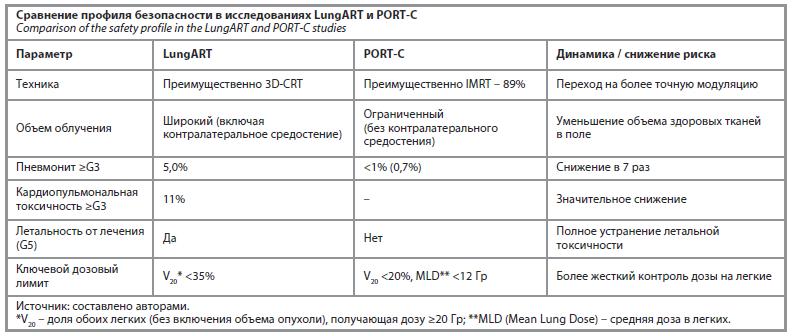
Применение современных технологий лечения (IMRT/ VMAT) позволяет снизить токсичность, сделав ПОЛТ более безопасной процедурой, что показано в исследовании PORT-C. Однако в обоих исследованиях, LungART и PORT-C, было продемонстрировано, что локальный контроль не конвертируется в улучшение показателя общей выживаемости у неотобранной популяции пациентов с рN2-статусом. Основной причиной смерти остаются отдаленные метастазы, которые не контролируются только облучением средостения. Таким образом, ПОЛТ не может рекомендоваться в рутинной практике и требует строгого отбора пациентов. Так, добавление ПОЛТ в рамках адъювантной терапии может рассматриваться у пациентов с наличием факторов высокого риска локального рецидива, таких как множественное поражение N2 узлов или экстракапсулярное распространение без перестроек в генах EGFR и ALK.
Заключение
Таким образом, решение о проведении адъювантной химиолучевой терапии должно приниматься мультидисциплинарной командой, учитывая индивидуальные факторы пациента, такие как общее состояние, сопутствующие заболевания. Послеоперационная химиолучевая терапия может рассматриваться как вариант лечения для небольшой когорты пациентов с высоким риском развития локорегионарного рецидива (множественное поражение N2 лимфоколлекторов, возникновение экстракапсулярных инвазий) без наличия активных драйверных мутаций (EGFR, ALK). Будущие исследования должны основываться на персонализации подходов, используя биомаркеры для идентификации пациентов, которые получат максимальную пользу от каждого вида терапии, а также на оптимизации комбинаций традиционных методов с новыми агентами для достижения наилучших результатов с минимальной токсичностью.
Список литературы доступен на сайте журнала https://klin-razbor.ru/
The list of references is available on the journal‘s website https://klin-razbor.ru/
Информация об авторах
Information about the authors
Саруханов Эдуард Андреевич – выпускник Обнинского института атомной энергетики – филиала ФГАОУ ВО «Национальный исследовательский ядерный университет “МИФИ”»
Обнинск, Россия. ORCID: 0009-0003-0639-2316; SPIN-код: 1495-4696
Eduard A. Sarukhanov – graduate, Obninsk Institute of Atomic Energy – branch of the National Research Nuclear University MEPhI. ORCID: 0009-0003-0639-2316; SPIN code: 1495-4696
Афонин Григорий Владиславович – канд. мед. наук, зав. отд-нием торакальной онкологии Медицинского радиологического научного центра им. А.Ф. Цыба – филиала ФГБУ «НМИЦ радиологии». ORCID: 0000-0002-7128-2397; SPIN-код: 9039-6110; ResearcherID: O-3150-2017; ScopusID: 57204696417
Grigoriy V. Afonin – Cand. Sci. (Med.), Tsyb Medical Radiological Research Centre – branch of the National Medical Research Radiological Centre. ORCID: 0000-0002-7128-2397;
SPIN code: 9039-6110; ResearcherID: O-3150-2017; ScopusID: 57204696417
Смоленов Евгений Игоревич – канд. мед. наук, ст. науч. сотр. отд-ния торакальной онкологии Медицинского радиологического научного центра им. А.Ф. Цыба – филиала ФГБУ «НМИЦ радиологии». ORCID: 0000-0003-3782-7338; SPIN-код: 6376-2673; ScopusID: 57202278816
Evgeny I. Smolenov – Cand. Sci. (Med.), Senior Res. Officer, Tsyb Medical Radiological Research Centre – branch of the National Medical Research Radiological Centre.
ORCID: 0000-0003-3782-7338; SPIN code: 6376-2673; ScopusID: 57202278816
Гулидов Игорь Александрович – д-р мед. наук, проф., заслуженный деятель науки России, зав. отд. лучевой терапии Медицинского радиологического научного центра им. А.Ф. Цыба – филиала ФГБУ «НМИЦ радиологии». ORCID:0000-0002-2759-297X; SPIN-код: 2492-5581
Igor A. Gulidov – Dr. Sci. (Med.), Full Prof., Honored Scientist of Russia, Tsyb Medical Radiological Research Centre – branch of the National Medical Research Radiological Centre.
ORCID: 0000-0002-2759-297X; SPIN code: 2492-5581
Прохожева Варвара Алексеевна – выпускница Обнинского института атомной энергетики – филиала ФГАОУ ВО «Национальный исследовательский ядерный университет “МИФИ”» Обнинск, Россия. ORCID:0009-0005-6213-7197; SPIN-код: 2699-1596
Varvara A. Prokhozheva – graduate, Obninsk Institute of Atomic Energy – branch of the National Research Nuclear University MEPhI. ORCID:0009-0005-6213-7197; SPIN code: 2699-1596
Иванов Сергей Анатольевич – чл.-корр. РАН, д-р мед. наук, проф. каф. онкологии и рентгенорадиологии им. В.П. Харченко Медицинского института ФГАОУ ВО «РУДН им. Патриса Лумумбы», дир. МРНЦ им. А.Ф. Цыба – филиала ФГБУ «НМИЦ радиологии».
E-mail: mrrc@mrrc.obninsk.ru; ORСID: 0000-0001-7689-6032; SPIN-код: 4264-5167
Sergey A. Ivanov – Corr. Memb. RAS, Dr. Sci. (Med.), Prof., Patrice Lumumba People’s Friendship University of Russia (RUDN University); Director, Tsyb Medical Radiological Research Centre – branch of the National Medical Research Radiological Centre. E-mail: mrrc@mrrc.obninsk.ru;
ORСID: 0000-0001-7689-6032; SPIN code: 4264-5167
Каприн Андрей Дмитриевич – академик РАН и РАО, д-р мед. наук, проф., зав. каф. онкологии и рентгенорадиологии им. В.П. Харченко Медицинского института ФГАОУ ВО «РУДН им. Патриса Лумумбы», дир. МНИОИ им. П.А. Герцена, ген. дир. ФГБУ «НМИЦ радиологии».
Е-mail: mrrc@mrrc.obninsk.ru; ORСID: 0000-0001-8784-8415; SPIN-код: 1759-8101
Andrey D. Kaprin – Acad. RAS, Dr. Sci. (Med.), Full Prof., RUDN University, Director of Hertsen Moscow Oncology Research Institute, General Director of National Medical Research Radiological Centre. Е-mail: mrrc@mrrc.obninsk.ru; ORCID: 0000-0001-8784-8415; SPIN code: 1759-8101
Поступила в редакцию: 23.06.2026
Поступила после рецензирования: 08.07.2026
Принята к публикации: 09.07.2026
Received: 23.06.2026
Revised: 08.07.2026
Accepted: 09.07.2026
Is there a place for postoperative chemoradiotherapy in the modern treatment of non-small cell lung cancer?
Eduard A. Sarukhanov1, Grigoriy V. Afonin2, Evgeny I. Smolenov2, Igor A. Gulidov2,Varvara A. Prokhozheva1, Sergey A. Ivanov2,3, Andrey D. Kaprin3,4,5
1 Obninsk Institute of Atomic Energy – branch of the National Research Nuclear University MEPhI, Obninsk, Russia;
2 Tsyb Medical Radiological Research Centre – branch of the National Medical Research Radiological Centre, Obninsk, Russia;
3 Patrice Lumumba People’s Friendship University of Russia (RUDN University), Moscow, Russia;
4 National Medical Research Radiological Centre, Obninsk, Russia;
5 Hertsen Moscow Oncology Research Institute, Moscow, Russia
sarukhanovea20@oiate.ru
Abstract
Non-small cell lung cancer is the leading cause of cancer death worldwide. Despite advances in diagnostics and treatment, the prognosis for patients with locally advanced disease, particularly with mediastinal lymph node-positive disease (pN2), remains poor.
Adjuvant drug therapy has become the standard of care for many patients with stage IB–IIIA NSCLC following curative surgery, demonstrating improved overall survival. However, the role of postoperative radiation therapy (PORT), specifically combination chemoradiotherapy, in the adjuvant setting for patients with pN2 disease remains a subject of intense research and debate.
Given the high heterogeneity of NSCLC and continually evolving treatment modalities, including the introduction of targeted therapies and immunotherapy, it is critical to reassess the optimal adjuvant treatment options for patients with non-small cell lung cancer. The aim of this study was to analyze the safety and efficacy of adjuvant chemoradiotherapy compared with adjuvant chemotherapy in patients with pN2 NSCLC after R0 resection, based on a review of current scientific publications.
The aim of this study was to analyze the safety and efficacy of adjuvant chemoradiotherapy compared to adjuvant chemotherapy in patients with pN2 NSCLC after R0 resection, based on the study of current scientific publications.
To conduct this comparative analysis, a systematic review of the current scientific literature published in peer-reviewed journals was performed using search queries for “non-small cell lung cancer,” “radical surgery,” and “postoperative radiotherapy.” The primary focus was on studies comparing adjuvant chemoradiotherapy and adjuvant chemotherapy in patients with stage pN2 NSCLC after radical surgery. Data analysis was performed considering overall survival, relapse-free survival, local control, and toxicity profiles. Particular attention was paid to identifying factors influencing the selection of the optimal strategy for individual patients.
Given current international guidelines, the routine use of PORT in patients with pN2 NSCLC is not recommended. The level of evidence supporting the combined chemoradiotherapy approach is inferior to that for adjuvant chemotherapy, necessitating a selective strategy: radiotherapy should only be considered in cases when predictive models indicate a high likelihood of benefit.
Keywords: non-small cell lung cancer, chemotherapy, radiation therapy, adjuvant chemoradiation therapy, mediastinal lymph node metastases.
For citation: Sarukhanov E.A., Afonin G.V., Smolenov E.I., Gulidov I.A., Prokhozheva V.A., Ivanov S.A., Kaprin A.D. Is there a place for postoperative chemoradiotherapy in the modern treatment of non-small cell lung cancer? Clinical review for general practice. 2026; 7 (7): 7–14 (In Russ.). DOI: 10.47407/kr2026.7.07.00p4569
Введение
Адъювантная химиотерапия на основе платины стала стандартом лечения для пациентов с немелкоклеточным раком легкого (НМРЛ) стадии II–IIIA после полной резекции, улучшая 5-летнюю общую выживаемость на 5–10% (абсолютный прирост) [1]. Данная терапия направлена на уничтожение микрометастазов, которые могли распространиться за пределы первичной опухоли и регионарных лимфатических узлов, тем самым снижая риск развития отдаленных рецидивов. Однако, несмотря на системное действие, адъювантная химиотерапия не всегда обеспечивает адекватный локальный контроль, что может способствовать возникновению локорегионарных рецидивов [1]. В этом контексте результаты исследования III фазы ADAURA открыли новые возможности для пациентов с мутациями в гене EGFR (ex19del или L858R). Применение адъювантного осимертиниба в течение 3 лет после радикальной операции продемонстрировало беспрецедентное преимущество в общей выживаемости: риск смерти был снижен на 51% [отношение рисков (ОР) 0,49; 95% доверительный интервал (ДИ) 0,34–0,70; p<0,0001], а 5-летняя общая выживаемость у пациентов со стадией IB–IIIA достигла 88% (в группе плацебо – 78%), причем этот эффект наблюдался вне зависимости от проведения предшествующей адъювантной химиотерапии [2]. Более того, препарат показал высокую эффективность в предотвращении метастазирования в центральную нервную систему (ЦНС): риск развития метастазов в ЦНС или смерти снизился на 64% (ОР 0,36; 95% ДИ 0,18–0,73) [2], что делает его новым стандартом терапии для данной подгруппы пациентов.
Послеоперационная лучевая терапия (ПОЛТ) при НМРЛ прошла долгий и противоречивый путь эволюции. В середине XX в. ПОЛТ широко применялась в общеклинической практике с целью улучшения локального контроля после хирургического этапа лечения пациентов с НМРЛ, исходя из предположения, что удаление опухоли не всегда гарантирует полное устранение микроскопических остаточных клеток [3, 4]. Однако первые рандомизированные исследования не показали явного преимущества в выживаемости, а некоторые даже намекали на возможный вред [4].
Одной из наиболее ключевых работ стал крупный метаанализ PORT Collaboration Group от 1998 г. [4]. В работе представлены результаты девяти рандомизированных исследований с участием 2128 пациентов, и результаты показали, что ПОЛТ после радикальной операции увеличивала смертность у пациентов с I и II стадией НМРЛ, а у пациентов с III стадией преимущества не были статистически значимыми (ОР 0,97 и 0,96 соответственно). Этот вывод привел к значительному сокращению использования ПОЛТ, особенно при ранних стадиях заболевания.
После публикации данного метаанализа исследователи осознали, что старые исследования имели ряд ограничений: устаревшие методики лучевой терапии (двухмерное планирование), большой объем облучаемых нормальных тканей, высокие дозы облучения, частое включение пациентов с N0/N1-статусом, которым ПОЛТ приносила больше вреда, чем пользы. Ярким примером тому стала отсроченная кардиальная летальность. Главный риск заключался в том, что пациенты умирали не от рецидива рака, а от сердечной недостаточности, вызванной лечением [4].
Начиная с 2000-х годов фокус внедрения ПОЛТ сместился на пациентов с поражением медиастинальных лимфатических узлов (рN2), у которых риск местного рецидива был значительно выше. Также совершенствование технологий: внедрение в общеклиническую практику позитронно-эмиссионной томографии, совмещенной с компьютерной томографией (ПЭТ/КТ), и методик лучевой терапии – трехмерной конформной лучевой терапии (3D-CRT) и модулированной по интенсивности лучевой терапии (IMRT) для более прецизионного облучения – позволило снизить риск развития осложнений со стороны сердечно-сосудистой системы.
Исследования ANITA (2006) [5] и NCIC CTG BR.10 (2006) [6], в которых изучалась роль адъювантной химиотерапии, показали, что добавление химиотерапии пациентам с N2-статусом НМРЛ ассоциировалось с улучшением выживаемости и локального контроля по сравнению с группой наблюдения.
Исследование ANITA (Adjuvant Navelbine International Trialist Association). Данная работа является крупным международным исследованием
III фазы, включавшим пациентов с НМРЛ после радикального хирургического лечения со стадиями IB (T2N0), II и IIIA. Основной целью было сравнение общей выживаемости у пациентов, получавших адъювантную химиотерапию, и пациентов, находившихся под наблюдением.
В период с декабря 1994 г. по декабрь 2000 г. 840 пациентов из 101 центра в 14 странах были рандомизированы в две группы: группу наблюдения после операции (n=433) и группу адъювантной химиотерапии (n=407). Пациенты в группе химиотерапии получали четыре цикла винкристина (навельбина) в дозе 30 мг/м2 еженедельно и цисплатина в дозе 100 мг/м2 каждые 4 нед.
Исследование продемонстрировало статистически значимое улучшение общей выживаемости в группе химиотерапии. ОР смерти составило 0,80 (95% ДИ 0,66–0,96; p=0,017). Абсолютное улучшение 5-летней выживаемости составило 8,6% (с 42,6% в группе наблюдения до 51,2% в группе химиотерапии); этот эффект сохранялся и через 7 лет наблюдения. Наибольшую пользу от лечения получили пациенты со стадиями II (улучшение 5-летней выживаемости на 13%) и IIIA (улучшение на 16%). Авторы отметили, что, хотя режим был эффективен, он оказался достаточно токсичным. Полный курс из четырех запланированных циклов завершили только половина пациентов. Наиболее частыми нежелательными явлениями 3–4-й степени были нейтропения (в том числе фебрильная) и анемия.
Стоит отметить, что 2% пациентов умерли от токсических эффектов, связанных с лечением, что выше, чем в аналогичных исследованиях. Исследователи предположили, что это может быть связано с относительно высокими дозами препаратов. Но данное исследование укрепило позиции адъювантной химиотерапии на основе винкристина и цисплатина как стандарта лечения для пациентов с операбельными стадиями НМРЛ (II–IIIA).
Исследование NCIC CTG BR.10 (JBR.10). В исследование включались пациенты после радикальных операцией по поводу НМРЛ IB (T2N0) и II (T12N1) стадии. Целью была оценка влияния адъювантной химиотерапии на общую и безрецидивную выживаемость.
Пациенты были рандомизированы в группу наблюдения или в группу, получившую четыре цикла химиотерапии винкристином и цисплатином. Важными особенностями этого исследования были более строгий отбор пациентов (только стадии IB и II) и отсутствие ПОЛТ в протоколе.
Результаты, впервые представленные в 2004 г. и опубликованные в 2005 г., показали снижение риска смерти на 30% (ОР 0,69; p=0,04). Абсолютное улучшение 5-летней выживаемости составило 15% (с 54% в группе наблюдения до 69% в группе химиотерапии), а медиана выживаемости увеличилась на 21 мес. Последующий анализ подтвердил, что этот положительный эффект сохраняется со временем. Отдельный ретроспективный анализ показал, что пациенты старше 65 лет также получают значительную пользу от химиотерапии (ОР 0,61; p=0,04), несмотря на то что они получили меньшие дозы препаратов и у них была приемлемая токсичность.
В исследовании ANITA нежелательные явления были существенными, однако поддавались коррекции. Пожилые пациенты получали меньшие дозы и реже завершали полный курс лечения, но частота тяжелых побочных эффектов и госпитализаций значимо не отличалась от таковой у более молодых пациентов.
Сравнение адъювантной химиолучевой терапии и адъювантной химиотерапии
Для пациентов с НМРЛ после радикальной резекции применение ПОЛТ теоретически обеспечивает преимущества в отношении как системного, так и локального контроля. Медикаментозная противоопухолевая терапия направлена на эрадикацию отдаленных микрометастазов, тогда как локальная лучевая терапия ориентирована на элиминацию резидуальных микроскопических опухолевых клеток в области оперативного вмешательства и регионарных лимфатических узлов.
У пациентов с патологически подтвержденной стадией pN2 после радикальной резекции (R0) адъювантная химиолучевая терапия теоретически обладает двойным онкологическим эффектом: системным контролем гематогенного метастазирования за счет химиотерапии и локорегионарным контролем остаточных субклинических опухолевых очагов в ложе удаленной опухоли и зонах регионарного лимфооттока посредством лучевого воздействия. В метаанализе Z. Wang и соавт. (2022), включившем 4111 пациентов, подтверждается, что ПОЛТ способствует повышению локального контроля, а у тщательно отобранных пациентов с НМРЛ и поражением лимфатических узлов (N2) может также улучшать общую выживаемость [7]. На сегодняшний день наиболее актуальными и доказательными исследованиями, оценивающими эффективность послеоперационной химиолучевой терапии, являются работы PORT-C и LungART [7–9].
Результаты исследований PORT-C и LungART. Исследование III фазы PORT-C, результаты которого были опубликованы в 2021 г., стало первым рандомизированным исследованием III фазы, оценивающим роль современной лучевой терапии после радикальной операции у пациентов с НМРЛ в китайской популяции. В исследуемой группе проводилась 3D-CRT или лучевая терапия с модулированной интенсивностью. В исследование были включены 394 пациента, но только
310 больных (из которых 140 получали ПОЛТ) были включены в финальный анализ.
Результаты исследования показали, что у пациентов, получивших ПОЛТ, был снижен риск местного рецидива по сравнению с контрольной группой (ОР 0,71; 95% ДИ 0,51–0,97). Однако это не привело к улучшению показателя безрецидивной выживаемости.
Важно отметить, что разницы в общей выживаемости между группами выявлено не было (ОР 1,02; 95% ДИ 0,68–1,52). Авторами отмечено, что было отсутствие зарегистрированных побочных эффектов 4-й или 5-й степени, связанных с лучевой терапией, и лишь у одного пациента (0,7%) наблюдался лучевой пневмонит 3-й степени [9].
В 2022 г. были опубликованы результаты многоцентрового исследования III фазы LungART. В исследовании, включающем 501 пациента, было показано, что ПОЛТ значительно снижает риск локорегионарного рецидива (14% против 23% в группе без ПОЛТ), но не влияет на выживаемость без признаков заболевания и общую выживаемость [8].
Стоит отметить, что нежелательные явления встречались чаще в группе ПОЛТ (89% против 74%), при этом особую обеспокоенность вызывала кардиопульмональная токсичность 3-й или 4-й степени, которая была зарегистрирована у 11% пациентов в группе ПОЛТ по сравнению с 5% пациентов в контрольной группе [9].
При интерпретации результатов исследований PORT-C и LungART необходимо обратить внимание на то, что в испытание PORT-C были включены только пациенты с заболеванием pIIIA-N2 согласно Международной классификации стадий злокачественных новообразований (TNM) 6-го или 7-го издания, что исключало пациентов с IIIB стадией (рN2) согласно 8-му изданию классификации TNM. В исследовании LungART эти пациенты не исключались (допускались ипсилатеральные очаги, pT4), но их результаты подробно не сообщаются, что ограничивает понимание эффективности ПОЛТ в этой конкретной популяции. Хотя доля таких пациентов, выбранных для хирургического лечения, невелика, они представляют собой подгруппу с особенно высоким риском местного рецидива и отдаленного метастазирования [9].
Также при оценке объема хирургической резекции в исследовании PORT-C количество обнаруженных лимфатических узлов и количество положительных лимфатических узлов рассматривались как факторы риска развития безрецидивной выживаемости. Она значительно различалась после стратификации в зависимости от количества обнаруженных и положительных лимфатических узлов (ОР 0,75; 95% ДИ 0,58–0,98), но выбранные пороговые значения не были опубликованы. Это подчеркивает необходимость более сложных инструментов отбора, учитывающих различные факторы риска.
В исследовании LungART был проведен пересмотр хирургических образцов в лаборатории для повторной оценки инвазии экстракапсулярных узлов, учитывая ее негативное влияние на выживаемость, выявленное в ранее опубликованном метаанализе [8]. После пересмотра только 28% пациентов были признаны радикально оперированными (R0), что поставило под сомнение адекватность патологической стадии у оставшихся 72% пациентов и предсказуемость резекции R0 перед операцией. Таким образом, представленные исследования подчеркивают критическую важность точной патологической оценки для прогнозирования риска и выбора оптимальной терапевтической тактики.
Также стоит отметить, что наиболее существенным ограничением является медленное накопление данных, что не позволило завершить эти испытания вовремя, чтобы идти в ногу с технологическим прогрессом в области лучевой терапии. Когда эти испытания разрабатывались, IMRT была инновационной техникой с ожидаемой пользой, которую еще предстояло полностью оценить.
Исследования PORT-C и LungART, несмотря на их ограничения, предоставляют важные данные о роли адъювантной лучевой терапии у пациентов с резецированным N2-статусом НМРЛ. Они показывают, что ПОЛТ может снижать риск местного рецидива, но не приводит к улучшению общей выживаемости и может сопровождаться повышенной токсичностью. Необходимы дальнейшие исследования для определения оптимальных кандидатов для ПОЛТ и разработки более точных прогностических моделей.
В популяционном когортном исследовании C.Y. Tu и соавт. от 2022 г. [10], фокусирующемся на пациентах с микроскопически позитивным краем резекции (R1), предоставлены данные для сравнения адъювантной химиолучевой терапии и химиотерапии. В этом исследовании проведение адъювантной химиолучевой терапии было связано с улучшенной общей выживаемостью по сравнению с адъювантной химиотерапией у пациентов с местно-распространенным НМРЛ и R1-резекцией. Это исследование показывает, что для пациентов с высоким риском локального рецидива добавление лучевой терапии к химиотерапии может быть выгодным. Несмотря на патоморфологические различия в статусе pN2 после радикальной резекции (R0) и неполной резекции (R1), высокий риск локорегионарного рецидива, характерный для обоих клинических случаев, обосновывает актуальность их сравнения.
В исследовании, направленном на поиск оптимального метода лечения НМРЛ после хирургического вмешательства с пораженными медиастинальными лимфатическими узлами, проанализированы данные из базы Surveillance, Epidemiology, and End Results (SEER), предоставляющие информацию об онкологических заболеваниях в США. В исследование включены пациенты с рN2 после радикального хирургического лечения, которым была проведена радикальная операция в период с 2010 по 2015 г. Пациенты были разделены на две группы: получавшие послеоперационную адъювантную химиотерапию и послеоперационную адъювантную химиолучевую терапию. Для минимизации систематических ошибок, связанных с различиями в характеристиках пациентов между группами, было применено сопоставление по методу статистической оценки (Propensity Score Matching, PSM). Основной конечной точкой исследования была общая выживаемость. Анализ данных показал, что пациенты, получавшие только адъювантную химиотерапию, имели статистически значимо лучшую общую выживаемость по сравнению с пациентами, получавшими адъювантную химиолучевую терапию, как до, так и после сопоставления по методу статистической оценки.
Медиана общей выживаемости в группе адъювантной химиотерапии составила 48 мес, в то время как в группе ПОЛТ – 39 мес (ОР 0,84; 95% ДИ 0,71–0,99; p=0,031) после статистической оценки [11]. Регрессионный анализ Кокса выявил ряд независимых прогностических факторов, влияющих на выживаемость. К факторам, ассоциированным с худшим прогнозом, относились: пожилой возраст (старше 60 лет), мужской пол, более высокая стадия T (T3–T4) и больший диаметр опухоли. Напротив, адъювантная химиотерапия без лучевой терапии была идентифицирована как благоприятный прогностический фактор [10]. На основе этих факторов была построена прогностическая модель, позволяющая оценить вероятность пользы от адъювантной химиотерапии. Модель показала хорошую предсказательную способность с AUC значений 0,723 для обучающей выборки, 0,710 для внутренней валидации и 0,729 для внешней валидации [11].
Дальнейший анализ позволил стратифицировать пациентов на группы с высокой и низкой вероятностью пользы от адъювантной химиотерапии. Пациенты из группы с высокой вероятностью пользы (вероятность пользы >0,62) демонстрировали значительно лучшую выживаемость при получении только химиотерапии по сравнению с группой адъювантной химиолучевой терапии [11].
Это исследование, основанное на анализе данных SEER (что соответствует реальной клинической практике), хоть и показывает, что адъювантная химиотерапия превосходит адъювантную химиолучевую терапию по показателям общей выживаемости у пациентов с НМРЛ и статусом рN2, но и свидетельствует, что необходимо более точно идентифицировать пациентов, которые могут получить наибольшую пользу от
адъювантной химиотерапии; это способствует персонализированному подходу к лечению. Таким образом, баланс между эффективностью и безопасностью является ключевым при выборе стратегии лечения.
Послеоперационное лечение НМРЛ: достижения лекарственной и лучевой терапии
Изначально иммунотерапия применялась только при метастатическом НМРЛ. На сегодняшний день взаимодействие лучевой терапии и иммунотерапии представляет собой область интенсивных и динамично развивающихся исследований в онкологии, хотя прямых и убедительных доказательств их синергического эффекта в периоперационных условиях пока еще недостаточно для широкого клинического применения [12]. Значительный прогресс в адъювантной терапии был достигнут в исследовании IMpower010, где атезолизумаб (ингибитор PD-L1) после адъювантной химиотерапии платиной сравнивался с наблюдением у пациентов с резецированным НМРЛ стадии IB–IIIA. В популяции с экспрессией PD-L1 ≥1% (стадии II–IIIA) атезолизумаб улучшил безрецидивную выживаемость (ОР 0,66; 95% ДИ 0,50–0,88), а наибольший эффект наблюдался при PD-L1 ≥50% (ОР 0,43). Однако терапия ассоциировалась с более высокой частотой нежелательных явлений 3–4-й степени (22% против 12% в группе наблюдения).
В свою очередь в исследовании PEARLS/KEYNOTE-091 оценивался адъювантный пембролизумаб (ингибитор PD-1) без обязательной предшествующей химиотерапии у пациентов с НМРЛ стадии IB–IIIA. В отличие от исследования IMpower010, пембролизумаб продемонстрировал значимое преимущество в DFS в общей популяции (ОР 0,76; 95% ДИ 0,63–0,91), включая пациентов с PD-L1 <1%, однако оно не достигло статистической значимости в подгруппе PD-L1 ≥50% (ОР 0,82; p=0,14). Частота серьезных нежелательных явлений составила 26% против 16% в группе плацебо.
Таким образом, оба исследования подтвердили роль адъювантной иммунотерапии при резецированном НМРЛ, однако ключевое различие заключается в том, что исследование IMpower010 показало эффект преимущественно при PD-L1 ≥1% (максимально – при PD-L1 ≥50%), тогда как исследование PEARLS/KEYNOTE-091 продемонстрировало пользу в общей популяции, включая пациентов с низкой экспрессией PD-L1, но без подтвержденного эффекта при высоком PD-L1 (≥50%). Несмотря на значительное улучшение показателей безрецидивной выживаемости и выживаемости без отдаленных метастазов, риск местного рецидива остается на уровне, наблюдавшемся до эры иммунотерапии. Это вновь оживляет интерес к ПОЛТ в контексте местного контроля [12].
Потенциально взаимодействие радиации и иммунотерапии активно изучается, хотя прямых доказательств в периоперационных условиях пока недостаточно. Лучевая терапия не только напрямую повреждает опухолевые клетки, но и может стимулировать иммунную систему посредством множества механизмов [13]. Помимо индукции двухцепочечных разрывов ДНК в опухолевых клетках, излучение вызывает высвобождение иммуностимулирующих молекул, ремоделирует сосудистую сеть опухоли и влияет на привлечение лимфоцитов в микроокружение опухоли [14]. Также отмечается, что радиотерапия может увеличивать экспрессию PD-L1 на опухоли, делая ее более чувствительной к ингибиторам иммунных контрольных точек [15]. Эти механизмы могут способствовать преимуществам лучевой терапии, когда системный иммунный ответ, вызванный радиотерапией, поддерживает отдаленную регрессию опухоли в так называемом ингибирующем эффекте.
Эти иммуномодулирующие механизмы могут способствовать возникновению феномена, известного как абскопальный эффект. Этот редкий, но системный иммунный ответ заключается в регрессии отдаленных, необлученных метастазов опухоли после локальной лучевой терапии первичного очага [12]. Абскопальный эффект является прямым доказательством способности лучевой терапии активировать системный противоопухолевый иммунитет.
Однако сочетание ПОЛТ и иммунотерапии вызывает опасения по поводу безопасности и потенциального иммуносупрессивного действия радиации. На эти эффекты влияют множество факторов, таких как общая доза, фракционирование, объем облучаемых тканей, общее время лечения и доза облучения ключевых органов, включая лимфатические узлы, селезенку и кости, содержащие костный мозг. Научный интерес к новым стратегиям, направленным на сохранение лимфоцитов, растет [16]. Это стимулирует проведение специализированных клинических испытаний, таких как исследование PACCELIO (NCT06102057), в котором оценивается корректировка дозы и целевых объемов для неоперабельного НМРЛ с целью снижения облучения здоровых лимфоидных структур [17]. Эти подходы, наряду с более широким использованием интенсивной модулированной по интенсивности лучевой терапии, прокладывают путь для дальнейших клинических испытаний, изучающих взаимодействие между радиацией и иммунной системой.
В ряде исследований, оценивающих адъювантную или периоперационную иммунотерапию, ПОЛТ являлась критерием исключения. Однако ряд исследований, изучающих влияние иммунотерапии в периоперационном периоде, допускали ПОЛТ при определенных обстоятельствах.
Например, в исследовании III фазы KEYNOTE-671 [18], оценивавшем периоперационную комбинацию пембролизумаба и химиотерапии при НМРЛ стадии II–IIIB после резекции (согласно TNM 8-го издания), пациентам с микроскопически положительными краями (R1), массивной остаточной болезнью или экстракапсулярным лимфатическим распространением была проведена ПОЛТ, в то время как пациенты с радикальной R0-резекцией и проведенной ПОЛТ и пораженными медиастинальными лимфатическими узлами были исключены.
Аналогичным образом, другие исследования фазы III допускали применение ПОЛТ по усмотрению исследователей, например CheckMate-816, изучающее неоадъювантное лечение ниволумабом с химиотерапией при резектабельном НМРЛ стадии IB–IIIA (согласно TNM 7-го издания) [19], CheckMate-77T, направленное на оценку влияния ниволумаба с химиотерапией при резектабельном НМРЛ стадии IIA–IIIB (согласно TNM 8-го издания) [20], и исследование AEGEAN, изучающее периоперационное лечение препаратом дурвалумаб в комбинации с химиотерапией при резектабельном НМРЛ стадии IIA–IIIB (согласно TNM 8-го издания)] [21].
Однако ПОЛТ проводили только небольшой подгруппе пациентов, в частности в случаях с высоким риском рецидива. Таким образом, взаимодействие иммунотерапии и лучевой терапии представляет собой перспективное направление в лечении НМРЛ. Понимание синергических механизмов и тщательная оценка безопасности комбинированного подхода являются ключевыми для разработки эффективных и безопасных стратегий. Дальнейшие клинические испытания, направленные на оптимизацию доз, объемов облучения и методов доставки радиации, будут иметь решающее значение для определения роли ПОЛТ в сочетании с иммунотерапией в будущем. Другими словами, современные исследования ПОЛТ при НМРЛ со статусом рN2 преимущественно направлены на выявление когорты пациентов, способных получить максимальный терапевтический эффект от такого лечения.
Согласно обновленным результатам фазы III рандомизированного исследования ADAURA адъювантное применение осимертиниба – необратимого ингибитора тирозинкиназы EGFR третьего поколения – устанавливает новый стандарт лечения пациентов с НМРЛ стадии IB–IIIA после полной резекции опухоли (R0) с наличием мутации в гене EGFR. В то время как стандартная адъювантная химиотерапия на основе платины традиционно обеспечивала лишь умеренное преимущество в 5-летней выживаемости (на 5–10%), таргетное воздействие осимертинибом позволило достичь беспрецедентного снижения риска смерти на 51% в общей популяции (ОР 0,49; 95% ДИ 0,34–0,70) [1, 2].
Особое внимание в исследовании уделено гетерогенности мутаций в гене EGFR. Анализ показал, что клиническая эффективность осимертиниба сохраняется на высоком уровне как при наличии делеции в 19-м экзоне (ex19del), так и при замене L858R в 21-м экзоне. Несмотря на то что опухоли с мутацией L858R традиционно считаются менее чувствительными к ингибиторам тирозинкиназы первого и второго поколения по сравнению с ex19del, в рамках исследования ADAURA осимертиниб продемонстрировал сопоставимое преимущество для обоих подтипов, что подчеркивает его высокую аффинность к мутантному рецептору и способность преодолевать механизмы первичной резистентности [22, 23].
Одним из наиболее значимых факторов в прогнозировании рецидива является состояние регионарных лимфоколлекторов. В исследовании ADAURA была подтверждена высокая эффективность препарата у пациентов с поражением лимфатических узлов. Так, при стадии N1 (поражение ипсилатеральных бронхопульмональных или корневых лимфатических узлов) и N2 (поражение ипсилатеральных медиастинальных лимфатических узлов) наблюдалось наиболее выраженное преимущество в безрецидивной выживаемости. Для пациентов со стадией IIIA (преимущественно N2-позитивных), где риск системного прогрессирования наиболее высок, снижение риска рецидива или смерти составило 88% (ОР 0,12) [22].
Способность осимертиниба элиминировать микрометастазы в лимфатической системе и предотвращать гематогенное распространение (в частности, в ЦНС, где риск снизился на 76%) радикально меняет прогноз для пациентов с местнораспространенным процессом. Нежелательные явления, такие как диарея, стоматит и пр., в подавляющем большинстве случаев соответствовали 1–2-й степени тяжести, что позволяло поддерживать высокую приверженность терапии в течение запланированных 3 лет [2, 24].
Таким образом, данные исследования ADAURA обосновывают необходимость обязательного изучения молекулярно-генетического профиля опухоли после резекции для своевременного назначения таргетной терапии, способной значимо увеличить шансы на полное излечение.
Результаты международного исследования III фазы ALINA ознаменовали собой фундаментальный сдвиг в лечении больных с НМРЛ и перестройкой гена ALK. Цитотоксическое воздействие химиопрепаратов на основе платинового дуплета демонстрирует ограниченную эффективность в предотвращении рецидивов при данном молекулярном подтипе.
Применение высокоселективного ингибитора тирозинкиназы второго поколения (алектиниб) в послеоперационном режиме терапии позволило снизить риск прогрессирования заболевания или летального исхода на 76% (ОР 0,24; 95% ДИ 0,13–0,43) у пациентов с IB–III стадией с перестройкой гена ALK в сравнении со стандартной химиотерапией в этой специфической когорте больных [25, 26].
Особый акцент в программе ALINA был сделан на оценке метастатического поражения ЦНС – риск возникновения церебральных метастазов был минимизирован на 78% (ОР 0,22). Это преимущество сохранялось и у пациентов с поражением медиастинальных лимфатических узлов (статус N2), где вероятность системного рецидива традиционно остается предельно высокой.
С точки зрения профиля безопасности преобладали нежелательные явления (повышение уровней креатинфосфокиназы и печеночных трансаминаз), в подавляющем большинстве случаев купированные без необходимости долгосрочной отмены препарата, что обеспечивает высокое качество жизни пациентов в период реабилитации.
Таким образом, данные исследования ALINA диктуют необходимость тестирования на транслокацию ALK у пациентов с аденокарцномой легкого после радикальной резекции для определения целесообразности таргетной терапии в адъювантном режиме [25, 27].
Обсуждение
Эволюция ПОЛТ при НМРЛ отражает общую тенденцию в онкологии к персонализированному подходу, когда выбор лечения основывается на глубоком понимании биологии опухоли, точном стадировании и использовании наиболее безопасных и эффективных методов терапии.
Таргетная терапия может использоваться в адъювантном режиме при НМРЛ при опухолях с определенными генетическими мутациями (мутации в гене EGFR, транслокация ALK). Результаты исследований, посвященных изучению влияния таргетной терапии в
адъювантном режиме при НМРЛ, показали преимущество по сравнению с химиотерапией или плацебо при оценке отдаленных результатов лечения. Однако процент пациентов с наличием драйверной мутации низок в общей популяции.
Выбор оптимальной адъювантной терапии для пациентов с местно-распространенным НМРЛ без активирующих мутаций и с поражением медиастинальных лимфатических узлов (pN2) после радикальной резекции остается сложной задачей. Адъювантная (иммуно)химиотерапия или таргетная терапия является основой системного лечения, улучшая общую выживаемость [28]. В современном мире применение ПОЛТ при НМРЛ у пациентов с пораженными медиастинальными лимфатическими узлами не является стандартом лечения для данной когорты, и добавление лучевой терапии в адъювантном режиме стоит рассматривать в тех случаях, когда высок риск развития локального рецидива, такого как множественное мультизональное поражение лимфоколлекторов. Большинство существующих исследований носят ретроспективный характер, что может приводить к искажению результатов из-за особенностей отбора пациентов и применения устаревших методик лучевой терапии. Это ведет к увеличению частоты развития кардиопульмональной токсичности, что может являться неизбежной и серьезной проблемой, приводящей к летальному исходу.
Как упоминалось ранее, адъювантная химиолучевая терапия сопряжена с повышенным риском токсичности, включая легочные и кардиальные осложнения. Два проспективных исследования III фазы продемонстрировали, что даже современная ПОЛТ не дает прироста выживаемости, несмотря на улучшение локорегионарного контроля и разницу в профиле безопасности.
В исследовании LungART, где для большинства пациентов использовалась методика 3D-CRT, была отмечена значительно более высокая частота кардиопульмональной токсичности 3–4-й степени в группе ПОЛТ (11%) по сравнению с контрольной группой (5%) [8]. Авторами не было продемонстрировано улучшение показателей безрецидивной и общей выживаемости.
В исследовании PORT-C применение IMRT со строгими ограничениями на объемы облучения (исключение контралатерального средостения) позволило снизить токсичность до минимума (доля тяжелых пневмонитов <1%). Несмотря на улучшение медиастинального контроля (14% рецидивов в группе ПОЛТ против 25% в группе химиотерапии), это также не привело к улучшению показателей безрецидивной или общей выживаемости [29]. Несмотря на отсутствие преимуществ в отношении общей выживаемости, количество нежелательных явлений было значительно ниже, чем в исследовании LungART, что продемонстрировано в таблице.
Применение современных технологий лечения (IMRT/ VMAT) позволяет снизить токсичность, сделав ПОЛТ более безопасной процедурой, что показано в исследовании PORT-C. Однако в обоих исследованиях, LungART и PORT-C, было продемонстрировано, что локальный контроль не конвертируется в улучшение показателя общей выживаемости у неотобранной популяции пациентов с рN2-статусом. Основной причиной смерти остаются отдаленные метастазы, которые не контролируются только облучением средостения. Таким образом, ПОЛТ не может рекомендоваться в рутинной практике и требует строгого отбора пациентов. Так, добавление ПОЛТ в рамках адъювантной терапии может рассматриваться у пациентов с наличием факторов высокого риска локального рецидива, таких как множественное поражение N2 узлов или экстракапсулярное распространение без перестроек в генах EGFR и ALK.
Заключение
Таким образом, решение о проведении адъювантной химиолучевой терапии должно приниматься мультидисциплинарной командой, учитывая индивидуальные факторы пациента, такие как общее состояние, сопутствующие заболевания. Послеоперационная химиолучевая терапия может рассматриваться как вариант лечения для небольшой когорты пациентов с высоким риском развития локорегионарного рецидива (множественное поражение N2 лимфоколлекторов, возникновение экстракапсулярных инвазий) без наличия активных драйверных мутаций (EGFR, ALK). Будущие исследования должны основываться на персонализации подходов, используя биомаркеры для идентификации пациентов, которые получат максимальную пользу от каждого вида терапии, а также на оптимизации комбинаций традиционных методов с новыми агентами для достижения наилучших результатов с минимальной токсичностью.
Список литературы доступен на сайте журнала https://klin-razbor.ru/
The list of references is available on the journal‘s website https://klin-razbor.ru/
Информация об авторах
Information about the authors
Саруханов Эдуард Андреевич – выпускник Обнинского института атомной энергетики – филиала ФГАОУ ВО «Национальный исследовательский ядерный университет “МИФИ”»
Обнинск, Россия. ORCID: 0009-0003-0639-2316; SPIN-код: 1495-4696
Eduard A. Sarukhanov – graduate, Obninsk Institute of Atomic Energy – branch of the National Research Nuclear University MEPhI. ORCID: 0009-0003-0639-2316; SPIN code: 1495-4696
Афонин Григорий Владиславович – канд. мед. наук, зав. отд-нием торакальной онкологии Медицинского радиологического научного центра им. А.Ф. Цыба – филиала ФГБУ «НМИЦ радиологии». ORCID: 0000-0002-7128-2397; SPIN-код: 9039-6110; ResearcherID: O-3150-2017; ScopusID: 57204696417
Grigoriy V. Afonin – Cand. Sci. (Med.), Tsyb Medical Radiological Research Centre – branch of the National Medical Research Radiological Centre. ORCID: 0000-0002-7128-2397;
SPIN code: 9039-6110; ResearcherID: O-3150-2017; ScopusID: 57204696417
Смоленов Евгений Игоревич – канд. мед. наук, ст. науч. сотр. отд-ния торакальной онкологии Медицинского радиологического научного центра им. А.Ф. Цыба – филиала ФГБУ «НМИЦ радиологии». ORCID: 0000-0003-3782-7338; SPIN-код: 6376-2673; ScopusID: 57202278816
Evgeny I. Smolenov – Cand. Sci. (Med.), Senior Res. Officer, Tsyb Medical Radiological Research Centre – branch of the National Medical Research Radiological Centre.
ORCID: 0000-0003-3782-7338; SPIN code: 6376-2673; ScopusID: 57202278816
Гулидов Игорь Александрович – д-р мед. наук, проф., заслуженный деятель науки России, зав. отд. лучевой терапии Медицинского радиологического научного центра им. А.Ф. Цыба – филиала ФГБУ «НМИЦ радиологии». ORCID:0000-0002-2759-297X; SPIN-код: 2492-5581
Igor A. Gulidov – Dr. Sci. (Med.), Full Prof., Honored Scientist of Russia, Tsyb Medical Radiological Research Centre – branch of the National Medical Research Radiological Centre.
ORCID: 0000-0002-2759-297X; SPIN code: 2492-5581
Прохожева Варвара Алексеевна – выпускница Обнинского института атомной энергетики – филиала ФГАОУ ВО «Национальный исследовательский ядерный университет “МИФИ”» Обнинск, Россия. ORCID:0009-0005-6213-7197; SPIN-код: 2699-1596
Varvara A. Prokhozheva – graduate, Obninsk Institute of Atomic Energy – branch of the National Research Nuclear University MEPhI. ORCID:0009-0005-6213-7197; SPIN code: 2699-1596
Иванов Сергей Анатольевич – чл.-корр. РАН, д-р мед. наук, проф. каф. онкологии и рентгенорадиологии им. В.П. Харченко Медицинского института ФГАОУ ВО «РУДН им. Патриса Лумумбы», дир. МРНЦ им. А.Ф. Цыба – филиала ФГБУ «НМИЦ радиологии».
E-mail: mrrc@mrrc.obninsk.ru; ORСID: 0000-0001-7689-6032; SPIN-код: 4264-5167
Sergey A. Ivanov – Corr. Memb. RAS, Dr. Sci. (Med.), Prof., Patrice Lumumba People’s Friendship University of Russia (RUDN University); Director, Tsyb Medical Radiological Research Centre – branch of the National Medical Research Radiological Centre. E-mail: mrrc@mrrc.obninsk.ru;
ORСID: 0000-0001-7689-6032; SPIN code: 4264-5167
Каприн Андрей Дмитриевич – академик РАН и РАО, д-р мед. наук, проф., зав. каф. онкологии и рентгенорадиологии им. В.П. Харченко Медицинского института ФГАОУ ВО «РУДН им. Патриса Лумумбы», дир. МНИОИ им. П.А. Герцена, ген. дир. ФГБУ «НМИЦ радиологии».
Е-mail: mrrc@mrrc.obninsk.ru; ORСID: 0000-0001-8784-8415; SPIN-код: 1759-8101
Andrey D. Kaprin – Acad. RAS, Dr. Sci. (Med.), Full Prof., RUDN University, Director of Hertsen Moscow Oncology Research Institute, General Director of National Medical Research Radiological Centre. Е-mail: mrrc@mrrc.obninsk.ru; ORCID: 0000-0001-8784-8415; SPIN code: 1759-8101
Поступила в редакцию: 23.06.2026
Поступила после рецензирования: 08.07.2026
Принята к публикации: 09.07.2026
Received: 23.06.2026
Revised: 08.07.2026
Accepted: 09.07.2026
Список исп. литературыСкрыть список1. Pignon JP, Tribodet H, Scagliotti GV et al. Lung Adjuvant Cisplatin Evaluation: a pooled analysis by the LACE Collaborative Group. J Clin Oncol 2008;26(21):3552-9. DOI: 10.1200/JCO.2007.13.9030
2. Tsuboi M, Herbst RS, John T et al. Overall Survival with Osimertinib in Resected EGFR-Mutated NSCLC. N Engl J Med 2023;389(2):102-14. DOI: 10.1056/NEJMoa2304594
3. Blliet C, Decaluwé H, Van Schil P et al. Postoperative radiotherapy in non-small cell lung cancer. Lung Cancer 2016;102:1-5. DOI: 10.1016/j.lungcan.2016.10.009
4. PORT Meta-Analysis Group. Postoperative radiotherapy in non-small-cell lung cancer: systematic review and meta-analysis of individual patient data from nine randomised controlled trials. Lancet 1998;352(9122):257-63.
5. Douillard JY, Rosell R, De Lena M et al. Adjuvant vinorelbine plus cisplatin versus observation in patients with completely resected stage IB-IIIA non-small-cell lung cancer (Adjuvant Navelbine International Trialist Association [ANITA]): a randomised controlled trial. Lancet Oncol 2006;7(8):641-50.
6. Winton T, Livingston R, Johnson D et al. Vinorelbine plus cisplatin vs. observation in resected non-small-cell lung cancer. N Engl J Med 2005;353(26):2767-74.
7. Wang Z, Yang B, Zhan P et al. The efficacy of postoperative radiotherapy for patients with non-small cell lung cancer: An updated systematic review and meta-analysis. J Cancer Res Ther 2023;19(3):567-75. DOI: 10.4103/jcrt.jcrt_167_22
8. Le Pechoux C, Pourel N, Barlesi F et al. Postoperative radiotherapy versus no postoperative radiotherapy in patients with completely resected non-small-cell lung cancer and proven mediastinal N2 involvement (Lung ART, IFCT 0503): an open-label, randomised, phase 3 trial. Lancet Oncol 2022;23(1):104-14. DOI: 10.1016/S1470-2045(21)00606-9
9. Men Y, Bao Y, Bi N et al. Long-term outcomes of postoperative radiotherapy for patients with pIIIA-N2 non-small-cell lung cancer after complete resection and adjuvant chemotherapy (PORT-C): a single-centre, randomized, phase 3 trial. Lancet Respir Med 2025 Nov (in press).
10. Tu CY, Chen HJ, Hsia TC, et al. Adjuvant Concurrent Chemoradiotherapy Versus Adjuvant Chemotherapy Only in Locally Advanced Non-small-cell Lung Cancer With Involved Microscopic Resection Margin: A Population-based Cohort Study. Anticancer Res 2022;42(6):3105-13. DOI: 10.21873/anticanres.15809
11. Liu L, Sun L, Guo L et al. Exploring the optimal treatment modality for non-small cell lung cancer after stage N2 surgery based on the SEER database and constructing a predictive model for the beneficiary population. Front Oncol 2024;14:1356721. DOI: 10.3389/fonc.2024.1356721
12. Смоленов Е.И., Афонин Г.В., Усачев В.С. и др. Возможности сочетания иммунотерапии с лучевой терапией в лечении больных неоперабельным местно-распространенным немелкоклеточным раком легкого. Исследования и практика в медицине. 2021;8(2):112-23. DOI: 10.17709/2409-2231-2021-8-2-10
Smolenov E.I., Afonin G.V., Usachev V.S. et al. Possibilities of combining immunotherapy with radiotherapy in the treatment of patients with inoperable locally advanced non-small cell lung cancer. Issledovaniya i praktika v medicine. 2021;8(2):112-23. DOI: 10.17709/2409-2231-2021-8-2-10 (in Russian).
13. Kumari S, Mukherjee S, Sinha D et al. Immunomodulatory Effects of Radiotherapy. Int J Mol Sci 2020;21(21):8151. DOI: 10.3390/ijms21218151
14. Deng L, Liang H, Burnette B et al. Irradiation and anti-PD-L1 treatment synergistically promote antitumor immunity in mice. J Clin Invest 2014;124(2):687-95. DOI: 10.1172/JCI67313
15. Ogliari FR, Huijs JWJ, Jongbloed M et al. Adjuvant radiotherapy in the era of new peri-operative systemic treatments for surgically resected non-small-cell lung cancer: where do we stand? Lung Cancer 2025;189:107524. DOI: 10.1016/j.lungcan.2025.107524
16. Lambin P, Lieverse RIY, Eckert F et al. Lymphocyte-Sparing Radiotherapy: The Rationale for Protecting Lymphocyte-rich Organs When Combining Radiotherapy With Immunotherapy. Semin Radiat Oncol 2020;30(3):187-93. DOI: 10.1016/j.semradonc.2019.12.003
17. A Study of Adjuvant Radiotherapy in Non-small Cell Lung Cancer (NSCLC). ClinicalTrials.gov Identifier: NCT06102057. URL: https://clinicaltrials.gov/study/NCT06102057
18. Wakelee H, Liberman M, Kato T et al. Perioperative Pembrolizumab for Early-Stage Non-Small-Cell Lung Cancer. N Engl J Med 2023;389(6):491-503. DOI: 10.1056/NEJMoa2302983
19. Forde PM, Spicer J, Lu S et al. Neoadjuvant Nivolumab plus Chemotherapy in Resectable Lung Cancer. N Engl J Med 2022;386(21):1973-85. DOI: 10.1056/NEJMoa2202170
20. Cascone T, Awad MM, Spicer JD et al. Perioperative Nivolumab in Resectable Lung Cancer. N Engl J Med 2024;390(19):1756-69. DOI: 10.1056/NEJMoa2311926
21. Heymach JV, Harpole D, Mitsudomi T et al. Perioperative Durvalumab for Resectable Non-Small-Cell Lung Cancer. N Engl J Med 2023;389(18):1672-84. DOI: 10.1056/NEJMoa2304875
22. Herbst RS, Wu YL, John T et al. Adjuvant Osimertinib for Resected EGFR-Mutated Stage IB-IIIA Non–Small-Cell Lung Cancer: Updated Results From the Phase III Randomized ADAURA Trial. J Clin Oncol 2023;41(10):1830-40. DOI: 10.1200/JCO.22.02186
23. Wu YL, Tsuboi M, He J et al. Osimertinib in Resected EGFR-Mutated Non–Small-Cell Lung Cancer. N Engl J Med 2020;383(18):1711-23. DOI: 10.1056/NEJMoa2027071
24. Wu YL, John T, Grohe C et al. Postoperative Chemotherapy and Outcomes With Adjuvant Osimertinib in Resected EGFR-Mutated NSCLC: ADAURA. J Thorac Oncol 2022;17(10):1230-43. DOI: 10.1016/j.jtho.2022.06.013
25. Solomon BJ, Ahn JS, Dziadziuszko R et al. Adjuvant Alectinib versus Chemotherapy in Resected ALK-Positive NSCLC. N Engl J Med 2024;390(14):1265-76. DOI: 10.1056/NEJMoa2310532
26. Wu YL, Dziadziuszko R, Ahn JS et al. Efficacy and safety of adjuvant alectinib versus chemotherapy in patients with early-stage ALK+ NSCLC: ALINA phase III study. J Clin Oncol 2023;41(36_suppl):LBA2. DOI: 10.1200/JCO.2023.41.36_suppl.LBA2
27. Peters S, Camidge DR, Shaw AT et al. Alectinib versus Chemotherapy in Untreated ALK-Positive Advanced Non–Small-Cell Lung Cancer. N Engl J Med 2017;377(9):829-38. DOI: 10.1056/NEJMoa1704795
28. Herbst RS, Tsuboi M, John T et al. Osimertinib as adjuvant therapy in patients with stage IB-IIIA EGFR mutation positive NSCLC after complete tumor resection: ADAURA. J Clin Oncol 2020;38(18_suppl):LBA5. DOI: 10.1200/JCO.2020.38.18_suppl.LBA5
29. Hui Z, Men Y, Hu C et al. Effect of postoperative radiotherapy for patients with pIIIA-N2 non-small cell lung cancer after complete resection and adjuvant chemotherapy: the phase 3 PORT-C randomized clinical trial. JAMA Oncol 2021;7(8):1178-85. DOI: 10.1001/jamaoncol.2021.1910
11 августа 2026
Количество просмотров: 160